RescueME R-Lab Policy Analysis
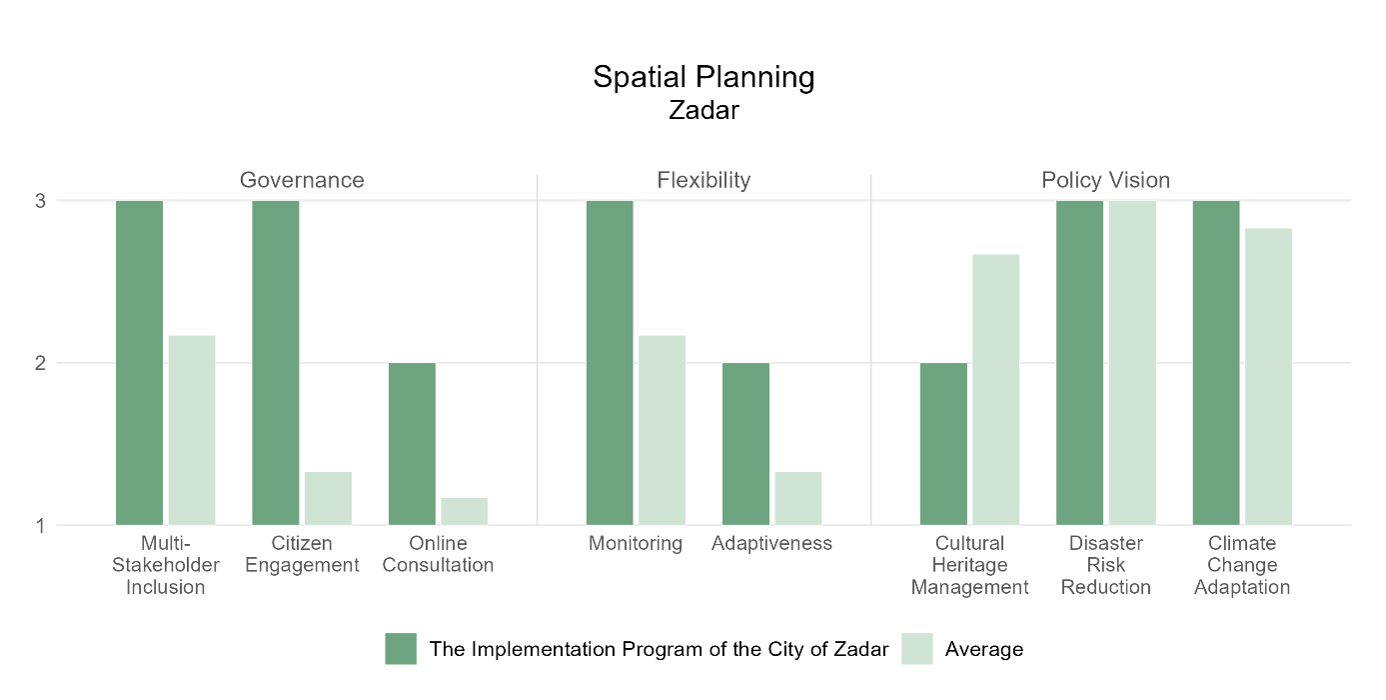
Example: Policy assessment of spatial planning for Zadar. Indicator values assigned to the Implementation Program of the City of Zadar and the average of all spatial planning tools relevant for Zadar.
What is a policy analysis?
The R-Lab (the RescueME case studies) Policy Analysis is a structured assessment of existing policy and planning instruments relevant to cultural landscapes. It describes the policy context of each landscape and analyses how current tools address spatial planning, cultural heritage management, climate change adaptation and disaster risk reduction.
The analysis combines policy mapping, questionnaire-based data collection, expert review and indicator-based assessment. It provides a bottom-up understanding of the current planning context and identifies where existing policy instruments already support resilience, and where gaps remain.
Why does policy analysis matter?
Building transformative resilience requires an in-depth understanding of the policy and planning context. Cultural landscapes are shaped by instruments operating across different governance levels, from national laws and strategies to regional plans and local tools. Without understanding this policy landscape, it is difficult to embed resilience measures into existing planning procedures.
The analysis helps identify gaps in three core dimensions: governance, policy vision and flexibility.
Governance refers to stakeholder involvement, citizen engagement and the accessibility of policy tools. Policy vision refers to the integration of spatial planning, cultural heritage management, climate change adaptation and disaster risk reduction. Flexibility refers to monitoring, revision, updating and adaptive mechanisms.
The results are used to define policy gaps and develop tailored recommendations for strengthening transformative resilience. They also support the development of long-term agendas by showing which actions can be connected to existing policy instruments and where new or updated provisions may be needed.
How was the policy analysis conducted?
Step 1: Collect relevant policy and planning instruments
Existing planning tools, strategies and policy instruments are collected for each cultural landscape. The collection covers spatial planning, cultural heritage management, climate change adaptation and disaster risk reduction across relevant governance levels.
Step 2: Map the policy landscape
The collected instruments are organised in a Policy and Planning Instruments Matrix. This matrix shows which policy tools exist, which policy domains they address, and at which administrative levels they operate.
Step 3: Review and complete the matrix
The matrix is checked with local coordinators and experts to confirm whether the most significant instruments have been identified and whether additional policy tools should be included.
Step 4: Gather structured information
A policy questionnaire is used to collect comparable information for each relevant instrument. It records general data, planning approach, responsible authorities, involved stakeholders, consultation options, online availability, aims, adaptiveness, monitoring and updating mechanisms, and links to cultural heritage management, disaster risk reduction and climate change adaptation.
Step 5: Select instruments for closer assessment
The most relevant instruments are selected for detailed analysis. Selection considers their relevance to the landscape scale, local challenges and priorities, adaptiveness, and representation of the four policy domains.
Step 6: Assess governance, policy vision and flexibility
The selected instruments are assessed through eight indicators grouped into three dimensions. Governance looks at stakeholder involvement, citizen engagement and accessibility. Policy vision looks at interconnections between policy domains. Flexibility looks at monitoring, review, updating and adaptive mechanisms.
Step 7: Identify policy gaps and recommendations
The assessment results are used to identify gaps in the current policy framework. These gaps form the basis for tailored policy recommendations and support the development of long-term action planning.
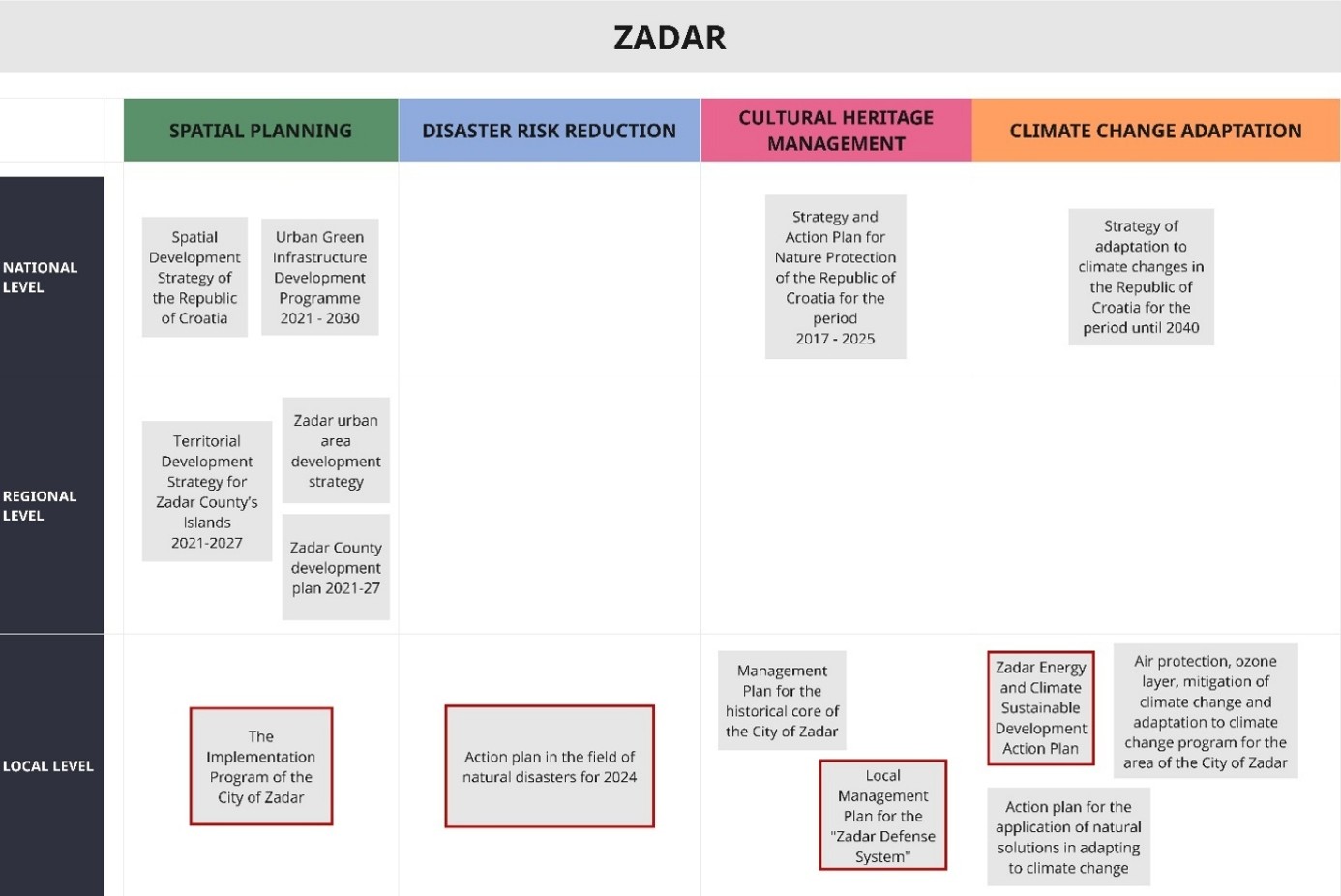
Example: Policy and planning instrument matrix for Zadar. Policy instruments selected for closer analysis are highlighted with a red border.