What is resilience?
Resilience can mean many different things to different people, depending on the context in which it is applied. One of the most common understandings of resilience is the often-called single-equilibrium resilience which assumes that a system is relatively static and has one stable state to which it should bounce back to. On the contrary ecosystem resilience or social resilience take a broader view and recognize that systems can have several stable states and that instead of bouncing back, they might need to adapt and “bounce forward” to a more suitable state to prepare them for future hazards.
Social-ecological resilience sees resilience as a dynamic process shaped by the interaction of social and ecological systems. Rather than a fixed condition resilience is understood as complex, cyclical and ever evolving depending on flexibility, continuous learning, and adaptation under uncertainty. In RescueME, this perspective is expanded to a social-ecological-technological understanding that also includes the built environment and highlights the interdependence of social, natural, and technological systems. In cultural landscapes, resilience must additionally account for their specific characteristics and the need to preserve identity, integrity, and authenticity.
RescueME therefore adopts the following definition of resilience of cultural landscapes:
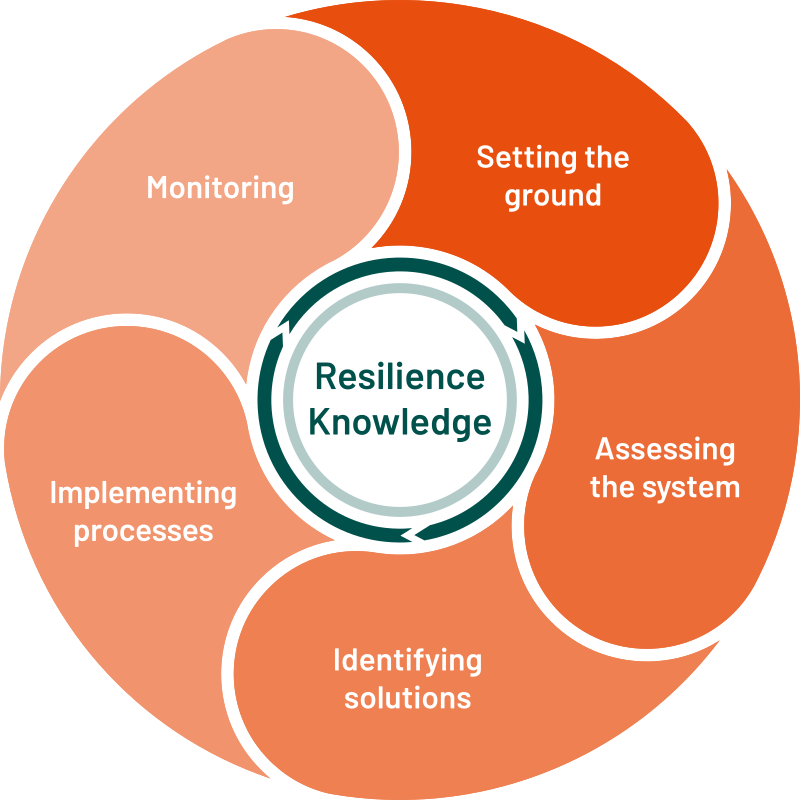
The Resilience Building Circle
Resilience of Cultural Landscapes
“Resilience of coastal cultural landscapes refers to the sustained capacity of both the landscapes and their communities—understood together as dynamic social-ecological-technological systems—to anticipate, absorb, adapt to, recover and learn from climate-related and other hazards. This includes maintaining or transforming ecological functions, cultural significance, and socio-economic roles in ways that are socially just, environmentally sustainable, and culturally appropriate.
It encompasses the ability of communities to reduce vulnerabilities, enhance adaptive and transformative capacities, and actively participate in safeguarding both tangible and intangible heritage values—ensuring continuity of identity, function, and governance across temporal and spatial scales.”
This definition specifically acknowledges that
- Cultural landscapes are socio-ecological-technological systems made up of more than just the natural environment
- Resilience is a continuous process that needs to be sustained, i.e. there is no ‘final state’ for resilience
- Resilience is dynamic and once a hazardous event has occurred, this needs to be seen as potential for the system and community to adapt, , and transform
- Any response and adaptation need to be socially just, environmentally sustainable and culturally appropriate.
- There are slow-onset stressors often induced by climate change as well as sudden-onset hazards to be acknowledged
What is a social-ecological-technological system?
The UNESCO World Heritage Centre (2008), defined cultural landscapes in three categories:
Cultural Landscape
1. A landscape clearly defined, designed and intentionally created by man, such as gardens and parklands
2. An organically evolved landscape, representing the process of evolution of their form and features. These can be divided into:
i) relict or fossil landscapes, if its evolution ended at some point in the past, and
ii) continuing landscape if it still maintains an active social role while still evolving
3. An associative cultural landscape, whose characteristics are based on religious, artistic or cultural associations of the natural element rather than material cultural evidence
Following this definition, RescueME understands cultural landscapes as:
Cultural Landscape
Landscapes whose character is the result of the historic action and interaction of natural and human factors with cultural significance for the communities that live in them.
It needs to be taken into account that cultural landscapes do not exist on their own, separated from the rest of the world, but are a system in which social, ecological and dimensions interact.
Hence RescueME sees cultural landscapes as social-ecological-technological systems:
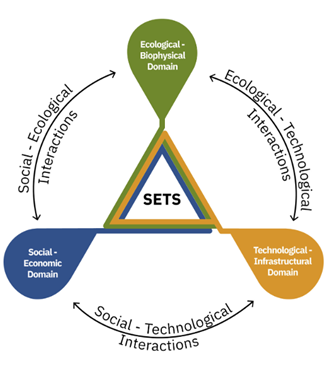
The social-ecological-technological systems (SETS) conceptual framework by McPhearson et al. (2022)
RescueME understands Cultural Landscapes to consist of three domains: the social dimension which can include policy and finance but also cultural norms and values, etc.; the ecological dimension which can consist of biodiversity, climate and weather etc. and the technological dimension which can encompass built infrastructure, sensors or automated systems etc. (see image above). These dimensions continuously interact with each other and thus reshape their relationship on a constant basis, which is why all three dimensions have to be considered for a holistic approach to resilience building.
References
UNESCO (2008): Operational Guidelines for the Implementation of the World Heritage Convention, online: https://whc.unesco.org/archive/opguide08-en.pdf#annex3.
McPhearson, T.; Cook, E.M.; Berbé s-Blázquez, M. et al. (2022): A social-ecological-technological systems
framework for urban ecosystem services, One Earth, Volume 5, pp. 505-518, https://doi.org/10.1016/j.oneear.2022.04.007.