Assessing the System
Understand your local setting!
The resources you can find here help you to gather and structure knowledge and data, with the aim of understanding the current state of resilience in your system.
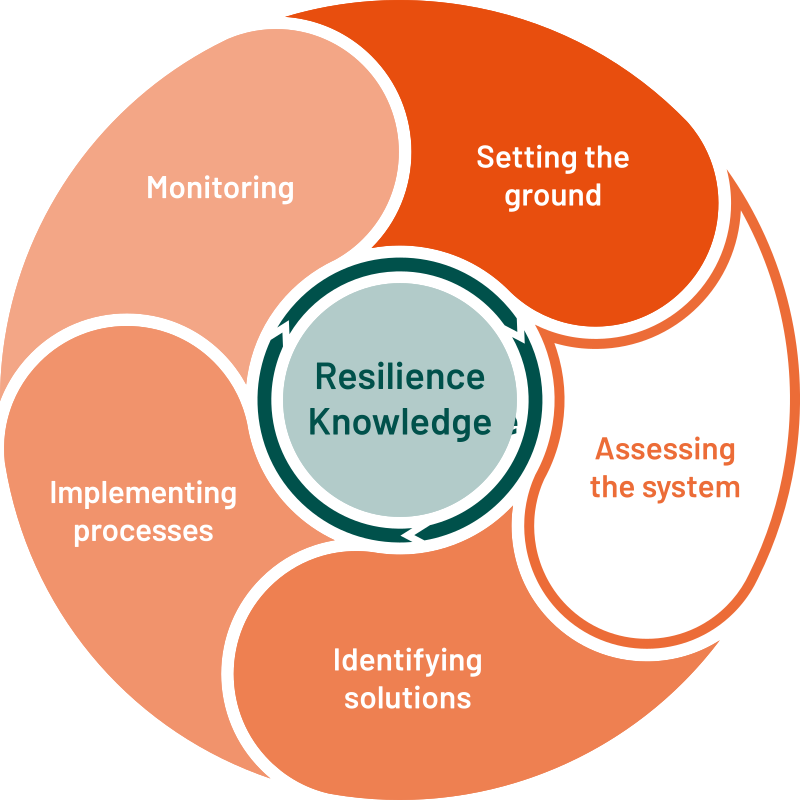
The Resilience Building Circle
Which threats is my system exposed to?
At the EU-level: What are the climatic and non-climatic hazards cultural landscapes are exposed to?
RescueME ATLAS
The RescueME ATLAS contains risk assessments and cultural landscape typologies for 513 coastal NUTS3 regions in Europe.
RescueME Policy Report
The Policy Report aims at providing promising policy actions in order to increase the resilience of european cultural landscapes.
At the local level: Which threats could my system be potentially exposed to?
RescueME Threats List
A collection of climatic and non-climatic threats that could affect a system meant as a starting point for evaluating which dangers a cultural landscape might face.
At the local level: Which parts/areas of my cultural landscape are most affected by the threats?
RescueME Local Risk Assessment
An assessment of the spatial distribution of risk at the local level.
Where do I get data on the threats and how do I manage the data?
RescueME Mapping Models
The Mapping Models generate delineation maps of floods, landslides and burned areas transforming raw observation data into actionable information.
RescueME Collection of Useful Links
This resource provides a collection of links to publically available data.
RescueME Geospatial Data Intelligent Platform
The RescueME Geospatial Data Intelligent Platform enables the structured collection, processing, analysis, and visualization of geospatial data.
What impacts do the threats have on my system?
At the EU-level: How will the risk for cultural landscapes evolve in the future?
RescueME ATLAS
The RescueME ATLAS contains risk assessments and cultural landscape typologies for 513 coastal NUTS3 regions in Europe.
RescueME Policy Report
The Policy Report aims at providing promising policy actions in order to increase the resilience of european cultural landscapes.
At the local level: What impacts do the threats have on my cultural landscape?
RescueME Impact Chains
Impact Chains describe how a climate signal (e.g. heatwaves) can trigger a series of impacts, which finally lead to a risk.
RescueME Chatbot
The Chatbot is a mobile conversational tool supporting communication in the context of natural hazard risk management.
RescueME Immersive AR Experience for Cultural Heritage Spaces
ARise is an augmented reality based mobile application designed to support cultural heritage preservation and resilience.
At the local level: How will the risk for cultural landscapes evolve in the future?
RescueME Local Risk Assessment
An assessment of the spatial distribution of risk at the local level.
RescueME ISDSS (Incremental Spatial Decision Support System)
The Decision-Support-System supports decision making based on multi-criteria evaluation of resilience measures in a local context.
How can my cultural landscape be characterized with regards to resilience?
At the EU-level: What types of cultural landscape can be distinguished with regards to their resilience strengths, weaknesses, challenges and attributes?
RescueME Framework
The RescueME Framework advances the understanding of resilience in the context of cultural landscapes.
RescueME ATLAS
The RescueME ATLAS contains risk assessments and cultural landscape typologies for 513 coastal NUTS3 regions in Europe.
RescueME Policy Report
The Policy Report aims at providing promising policy actions in order to increase the resilience of european cultural landscapes.
At the local level: What are the resilience strengths, weaknesses, challenges and attributes of my cultural landscape?
RescueME Resilience Baseline Survey
The Resilience Baseline Survey was used to assess the resilience baseline condition among all RescueME pilot sites.
RescueME Impact Chains
Impact Chains describe how a climate signal (e.g. heatwaves) can trigger a series of impacts, which finally lead to a risk.
At the local level: How can I assess the contribution of my cultural heritage?
RescueME Social Media Analysis
The Social Media Data Analysis tool automatically fetches, filters, and analyses available posts from targeted social media platforms.
RescueME Heritage Value Assessment
The Heritage Value Assessment is a holistic approach to heritage value assessments that incorporates heritage values relating to the natural environment and intangible aspects.
RescueME Framework
The RescueME Framework advances the understanding of resilience in the context of cultural landscapes.
Where do I get data and how do I manage the data?
RescueME Collection of Useful Links
This resource provides a collection of links to publically available data.
RescueME Geospatial Data Intelligent Platform
The RescueME Geospatial Data Intelligent Platform enables the structured collection, processing, analysis, and visualization of geospatial data.
What does the current policy landscape in my area look like?
RescueME R-Lab Policy Examples
These are some examples from our R-labs on what policies and strategies were relevant for them.
RescueME Policy Based Best Practice Collection
The Policy Based Best Practice Collection is a literature-based collection of resilience-related policies.