The RescueME Framework
The RescueME Framework is a structured, indicator-based approach designed to assess and enhance the resilience of Cultural Landscapes in the face of hazards and climate change. It supports the development of actionable, evidence-based strategies for heritage conservation and sustainable development by integrating local knowledge with scientific methods.
What is the RescueME Framework?
The RescueME Framework is a conceptual model that enables the characterization of cultural landscape values and resilience through a set of measurable indicators. It is grounded in a capital-based approach, which considers the interplay between different types of capital — including natural, social, financial, human, and built — and their role in enhancing resilience.
The framework is specifically designed to support cultural landscapes by measuring resilience across the sensitivity and adaptive capacity components, which are assessed using a set of indicators that reflect the vulnerability dimensions of cultural landscapes, allowing for a comprehensive evaluation of their resilience potential.
Why and how was the RescueME Framework developed?
Cultural landscapes are increasingly threatened by climate change, natural hazards, and socio-economic shifts. However, existing resilience assessment tools often fail to capture the unique complexity of these heritage and cultural-rich environments.
The RescueME Framework addresses this gap by:
- Adapting the CWA 17727:2022 standard (“City Resilience Development — Guide to combine disaster risk management and climate change adaptation — Historic areas”) to a landscape-scale approach.
- Integrating insights from previous EU-funded projects such as SHELTER, ARCH and RURITAGE.
- Creating a GLOCAL strategy — combining global standards with local knowledge — to ensure relevance and scalability across different regions.
The framework was developed through a multi-step process:
- Literature review: A review of existing research on cultural landscape resilience.
- Indicator development: A set of indicators was proposed to measure cultural landscape values and resilience, aligned with the social‑ecological‑technical systems and their associated capitals.
- Conceptual integration: The framework integrates the Cultural Ecosystem Services concept, emphasizing the role of heritage — both tangible and intangible — in improving quality of life and community well-being.
- Co-creation and validation: The framework is designed to be used in co-creation processes with stakeholders, including heritage managers, local authorities, and practitioners, ensuring its practical applicability.
Key components of the Framework
The RescueME Framework is built around three core systems — social, ecological, and technical — each of which is linked to specific types of capital: natural, social, financial, human, and built, composed by key elements. These systems, capitals and key elements form the foundation of the framework, reflecting the interconnected nature of cultural landscapes and their resilience. Central to this approach is an indicator-based assessment, which uses measurable, evidence-based criteria to evaluate resilience across different dimensions. This data-driven method enables stakeholders to make informed decisions, track progress, and identify areas where intervention is most needed. The integration of these components ensures that the framework is both comprehensive and practical, supporting effective planning and management of cultural landscapes in the face of increasing environmental and social challenges.
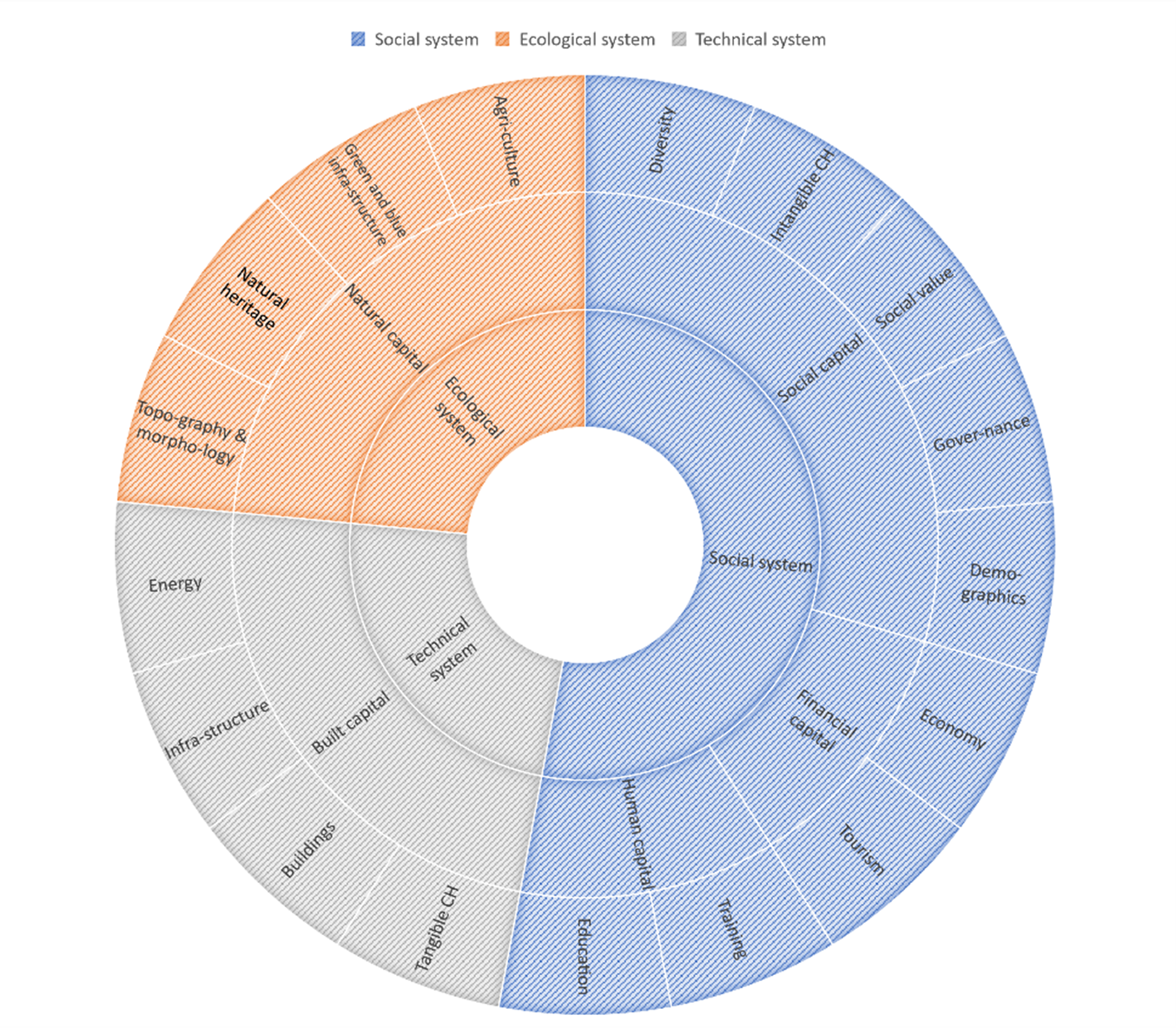
The RescueME indicator framework for Cultural Landscape values and resilience characterization