RescueME Impact Chains
What are Impact Chains?
Impact chains are a practical way to understand how climate‑related risks emerge within social‑ecological‑technical systems (SETS). These systems bring together people and communities, ecosystems and land uses, and the technical and built infrastructures that shape daily life. RescueME uses this SETS perspective because cultural landscapes are not just places — they are living systems where social practices, ecological processes, heritage features, and infrastructures depend on each other.
Impact chains describe how a climate signal (for example, extreme rainfall, heatwaves, drought, or storm surges) can trigger a series of impacts, which — together with exposure and vulnerability — lead to a risk. They help make these interactions visible and easier to discuss among people who bring different kinds of knowledge.
Why Impact Chains Matter for Resilient Cultural Landscapes
Cultural landscapes emerge from long-term interactions between people, ecosystems, infrastructures, and cultural practices. Climate change disrupts these interactions through extreme rainfall, heatwaves, drought, storms, and shifting seasonal patterns. These hazards interact with vulnerabilities across all parts of the system and can produce cascades of effects.
Impact chains help make these dynamics understandable. They show, step by step, how a hazard affects different parts of the social‑ecological‑technical system. For example, strong rainfall can damage traditional water infrastructure. When this happens, the consequences are not limited to the physical structure: agricultural routines, community water access, terrace stability, and cultural practices linked to irrigation may all be affected. Seeing these relationships together helps avoid fragmented or overly technical interpretations.
Impact chains also clarify what cannot be influenced (such as the occurrence of a storm) and what can. This is crucial for developing practical adaptation measures — from stabilising slopes or maintaining traditional water systems to improving communication between local actors or strengthening community preparedness.
Because cultural landscapes involve many actors, each with different responsibilities and perspectives, impact chains help create a shared basis for discussion and decision-making. They provide a neutral, easy-to-understand structure that brings together different types of knowledge and shows how they fit into the bigger picture.
Impact chains also provide a foundation for selecting indicators that can be used to monitor resilience over time, covering social, ecological, technical, and cultural dimensions.
How are Impact Chains Created?
Impact chains in RescueME are co-created through an iterative process that combines scientific information with the knowledge and experience of local actors in workshops. This is essential in a SETS perspective: resilience depends on integrating social, ecological, and technical insights.
Usually, the hazard part of the impact chain is prepared before the workshop based on climate data and local observations. This allows the workshop to focus on exposure, impacts, and vulnerabilities, where local knowledge is most important.
During the workshop, participants identify what is exposed — not only heritage structures and ecological features, but also people, livelihoods, infrastructures, cultural practices, and community functions.
Participants then identify impacts across the social‑ecological‑technical system:
- social impacts (wellbeing, social cohesion, cultural activities),
- ecological impacts (vegetation stress, soil erosion),
- technical impacts (infrastructure failure or reduced functionality),
- cultural impacts (damage to heritage or practices), and
- economic impacts (agriculture, tourism, or local services).
Next, participants explore vulnerabilities, including sensitivity (the condition of structures, landscapes, and ecosystems) and adaptive capacity (institutional cooperation, availability of expertise, traditional knowledge, maintenance routines, financial means, and social networks).
The workshop results form an initial sketch of the impact chain. After the workshop, researchers refine this sketch, clarify relationships, and incorporate additional data. The updated chain is then reviewed by participants to ensure it reflects their understanding and experience.
This iterative process produces an impact chain that is scientifically sound, locally grounded, and widely supported. It becomes a shared framework for selecting indicators, structuring risk assessments, communicating insights, and developing adaptation measures that strengthen resilience across the social‑ecological‑technical system.
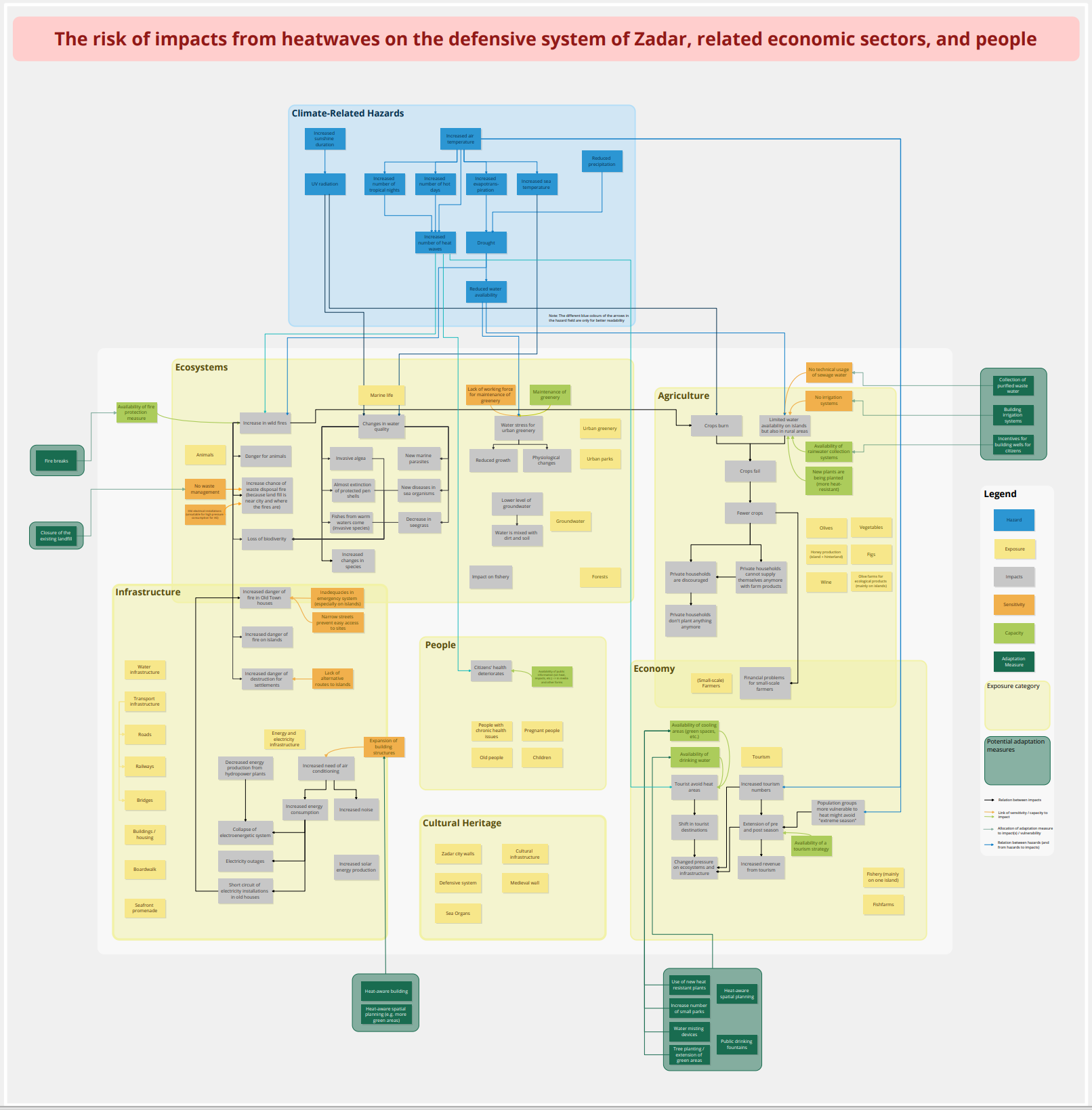
Exemplary Impact Chain developed in RescueME