RescueME Long term agenda for transformative resilience
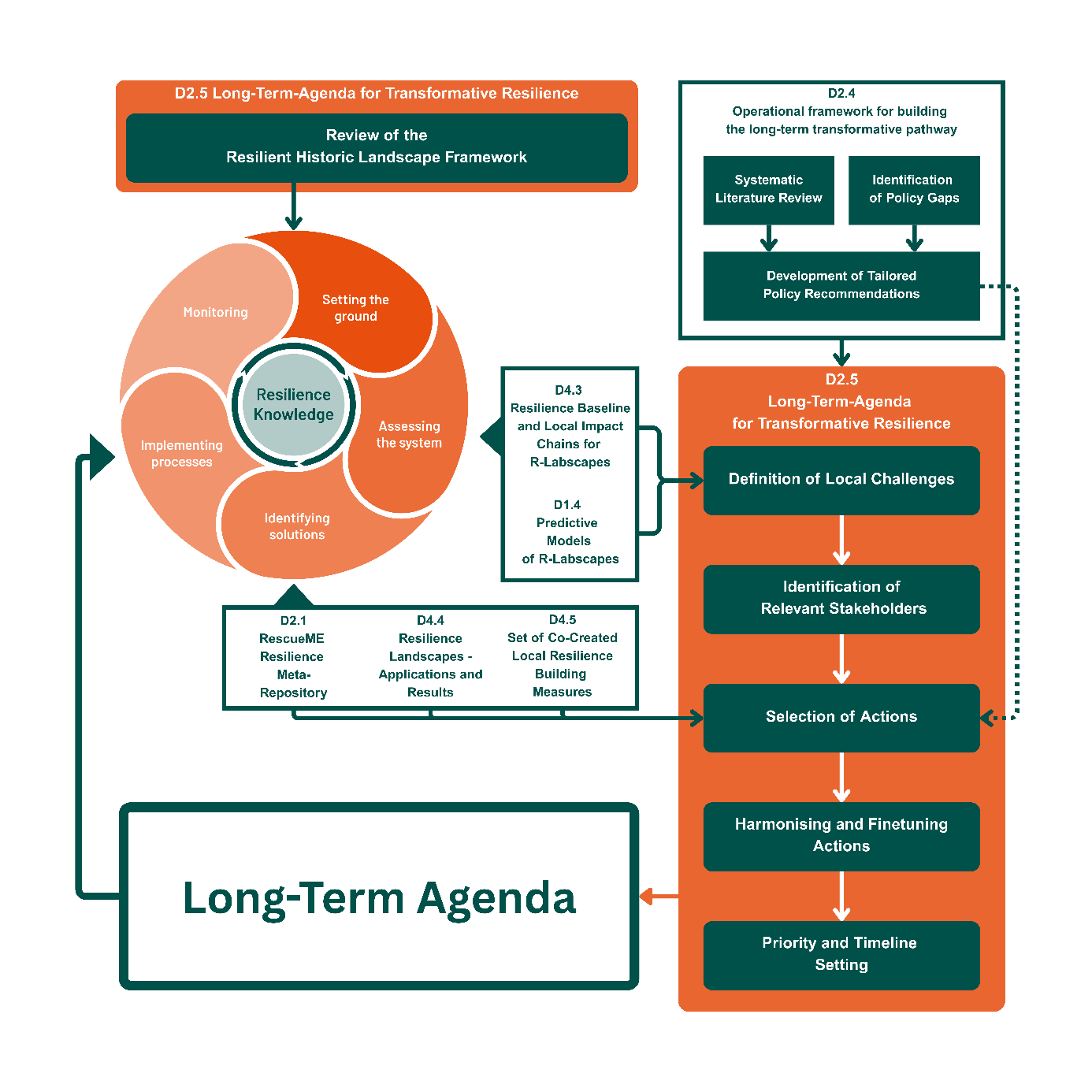
Methodological workflow of developing the long-term agenda
What is a long-term agenda?
It is a roadmap to support local governments, stakeholders and communities in building their cultural landscape resilience through a dynamic, adaptive and flexible approach. It includes sustainable and resilient strategies and actions, based on co-creation and collaborative decision-making processes. The long-term agenda is the key step in translating insights from the “Assessing the system” and “Identifying solutions” steps of the Resilience Building Circle into actionable outcomes.
In the scope of the RescueME project, the five tailored long-term agendas have been developed, one for each R-Lab (the RescueME case studies), integrating the most relevant project’s results and outputs.
Why does the long-term agenda matter?
European coastal cultural landscapes are threatened by multiple risks, including climate change, increased disaster risk, loss of tangible and intangible heritage, ecological pressures and socio-demographic challenges. These risks are complex and interconnected, and directly linked to policy strengths and gaps, so they require more than incremental improvement.
The agenda supports transformative resilience by helping individuals, organisations and systems deliberately change structures, functions and pathways that produce vulnerability. It provides a clear structure for evidence-based decision-making and helps turn project results, local knowledge and co-created measures into concrete implementation pathways.
The result is a locally grounded agenda that identifies relevant actions, connects them to local challenges and policy gaps, and assigns them to realistic implementation timeframes.
How is does the long-term agenda look like?
The agenda follows four guiding questions:
Location: For which cultural landscape is the agenda developed?
This section describes the social, economic, ecological and cultural context of the landscape and highlights its specific attributes.
People: Who is the agenda for?
This section identifies the authorities, stakeholders and local actors that should be addressed, consulted or involved in implementation.
Challenges and policy gaps: Why is the agenda necessary?
This section synthesises the main climate, environmental, socio-economic and cultural threats, together with gaps in governance, policy vision and flexibility.
Actions: How does the agenda address these challenges and gaps?
This section presents tailored actions selected, harmonised and fine-tuned for the local context. Each action is linked to the challenges it addresses, the policy gaps it aims to improve, the involved resilience capitals, and its origin.
The actions are prioritised and assigned an implementation timeframe. The final output is a clear action matrix that shows what should be done, when it should be done, and how each action contributes to transformative resilience.
How was the long-term agenda developed?
Step 1: Apply the resilience framework
The agenda starts from the resilience framework used to understand cultural landscapes as interconnected socio-ecological systems. This provides the common structure for linking heritage values, local capacities, hazards and resilience actions.
Step 2: Build the operational framework
The operational framework translates the resilience framework into a practical structure for developing long-term transformative pathways. It provides a blueprint for the the selection of suitable actions and the prioritisation of implementation steps through the identification of policy gaps and policy recommendations.
Step 3: Define the local challenges
The main climate, environmental, socio-economic and cultural challenges are identified by bringing together local resilience baselines, impact chains, predictive models and policy analysis results. This step clarifies why action is needed in the specific landscape.
Step 4: Identify relevant stakeholders
The agenda identifies the public authorities, local communities, economic actors, heritage and environmental organisations, technical experts and other stakeholders that should be consulted or involved in implementation.
Step 5: Select suitable actions
Actions are selected from existing RescueME outputs, including the resilience meta-repository, the serious game workshops and the co-created local resilience measures. The selection focuses on actions that respond directly to the identified challenges and policy gaps.
Step 6: Harmonise and fine-tune actions
The selected actions are adapted to a shared format and refined for the local context. Each action is linked to the challenges it addresses, the policy gaps it aims to improve, the involved resilience capitals, and its origin.
Step 7: Prioritise actions and define timeframes
The actions are prioritised and assigned to short-term, medium-term, long-term or far-future implementation timeframes. Where needed, actions can cover several timeframes when implementation is continuous or expected to last longer.
Step 8: Build the final agenda
The final output is a clear action matrix that shows what should be done, who should be involved, which challenges and gaps are addressed, and when implementation should take place.
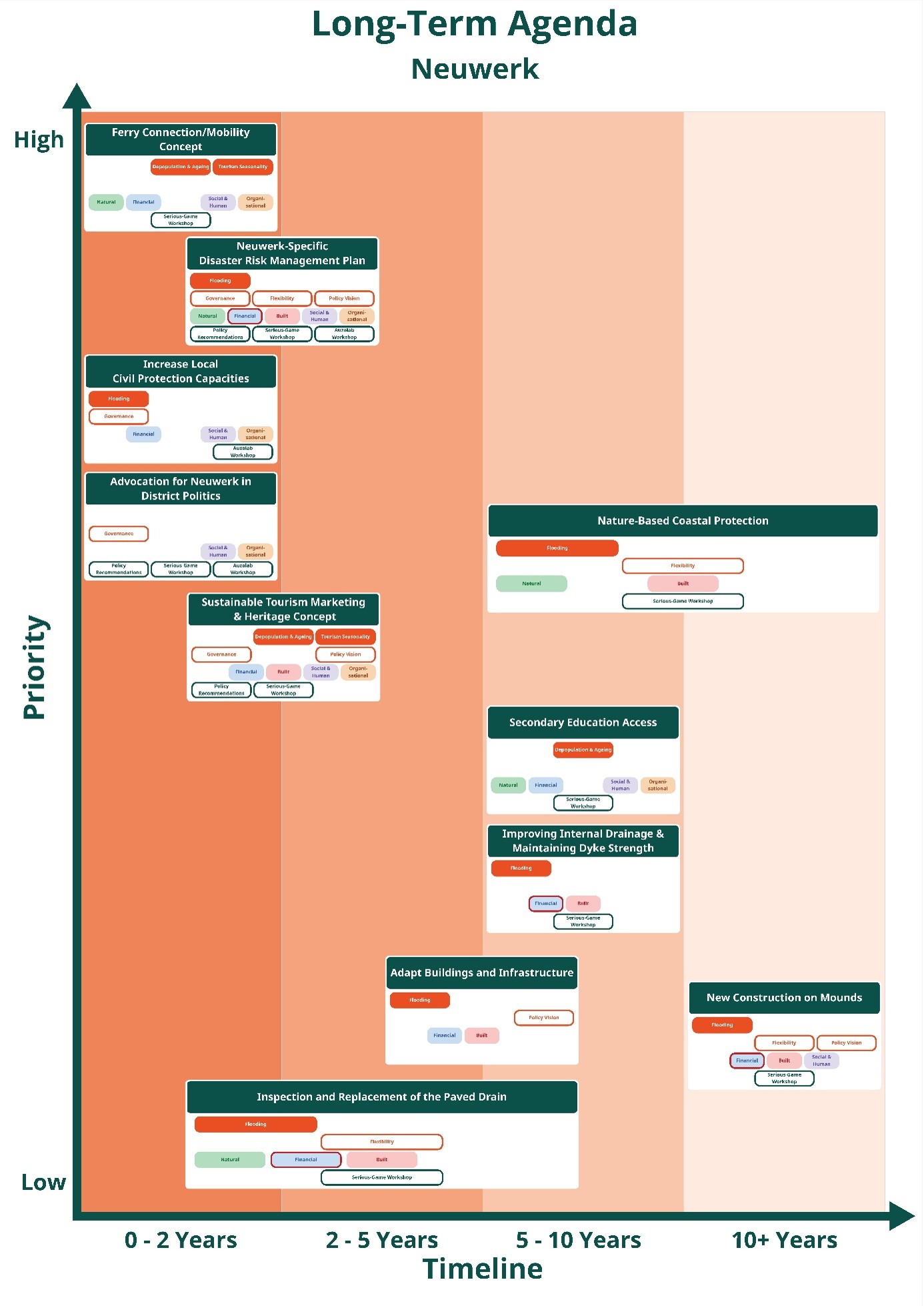
Long-term agenda for Neuwerk, presented as actions in a matrix of timeline and priority.