Co-creation Framework
Co-creation within the RescueME project entails the collaborative engagement of diverse local stakeholders in the development of resilience measures and strategies in each of the 5 R-labscapes. In the RescueME co-creation process local stakeholders will work together to define common goals and collaboration pathways, thus enhancing the value and relevance of the consequent resilience measures and strategies to their local contexts. Successful implementation of project tasks requires the engagement of diverse partners and stakeholders at different levels, contexts and timeframes. Four levels of engagement are defined within the RescueME framework to distinguish co-creation activities in the five R-labscapes from other internal and external project interactions.
1. Why co-creation?
Co-creation is a collaborative approach that brings together multiple stakeholders, such as researchers, policymakers, local authorities, industry actors, civil society organisations, and local communities, and encourages participation in the design, implementation and evaluation of RescueME measures and solutions. By doing this, co-creation not only relies on experts’ opinions, but also integrates the perspectives and knowledge of those directly affected by the challenges and the proposed interventions.
Key benefits of co-creation:
- Local Knowledge Integration: local communities possess context-specific knowledge about their cultural, environmental, and social contexts that needs to be accounted alongside scientific expertise.
- Legitimacy and trust: stakeholder participation increases transparency and acceptance from all contributors.
- Equity and inclusion: co-creation promotes equitable participation, giving voice to marginalised groups and ensuring that resilience measures are just and inclusive.
- Sustainability and long-term impact: co-creation solutions are more likely to be supported and implemented in the long-term when stakeholders have been actively involved.
- Innovation: collaboration across sectors offers diverse perspectives and fosters creative and interdisciplinary solutions.
In RescueME, co-creation turns into a structured, iterative process where stakeholders are both co-generators and co-validators of knowledge, actively designing resilience measures from conception to implementation.
2. What’s a co-creation framework?
A co-creation framework is a structured guide that defines how co-creation can be implemented within a project. It defines the principles, processes, tools and roles for facilitating collaborative innovation between project partners to achieve shared goals.
Specifically, the framework defines:
- Who participates: stakeholders, local communities, experts, and institutions.
- When and how participation takes place: through workshops, consultations, co-design sessions, and other engagement formats.
- Methods and tools used: participatory workshops, surveys, digital tools, living labs, and other collaborative methodologies.
- Outputs and integration mechanisms: such as policy recommendations, digital tools, repository of measures, resilience strategies, and the coordination and alignment of activities across the project.
2.1 Levels of participation:
The co-creation framework distinguishes between different levels of engagement to clarify roles and expectations:
- Collaboration: internal collaboration among project partners and experts.
- Co-creation: active joint design and development of solutions with stakeholders.
- Consultation: validation of results and collection of feedback from experts or communities of practice.
- Dissemination: communication of outcomes to wider audiences, decision-makers, and policymakers.
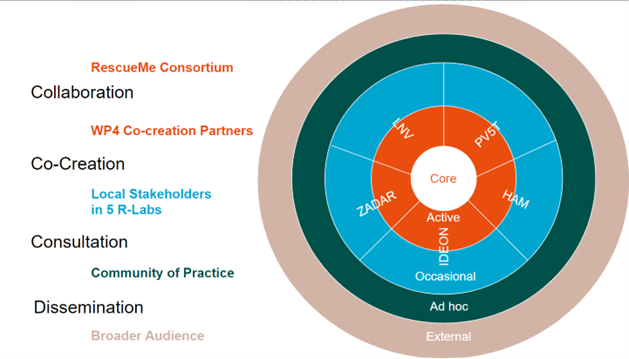
Levels of Engagement in RescueME
2.2 Key components of a co-creation framework
- Guiding principles: a set of main principles and values that support collaboration and decision-making, including equality, openness, transparency, flexibility, inclusiveness, and trust ((see below 3.1 Methodological Approach and Guiding Principles in RescueME).
- Processes and activities: RescueME co-creation framework describes a structured methodology for engagement, based on the following components: mentoring scheme, community meetups, online and in-person workshops, local actions. and community conversations (see below 3.2 Co-creation Processes in RescueME).
- Integration mechanisms: alignment of co-creation activities with broader project tasks, deliverables, and work packages.
- Barrier mitigation strategies: approaches to address power imbalances, limited stakeholder capacity, digital fatigue, difficulties in data collection, institutional constraints, and political and contextual changes among others.
2.3 Contribution of co-creation to the projects objectives
A co-creation framework aims to support evidence-based decision-making, co-design strategies and tools with users, enhance stakeholder capacity and empowerment, foster knowledge exchange between science, policy, and society, monitor impact and participation, and enable the transferability and scalability of solutions. In RescueME, the co-creation framework is designed to be adaptive and context-sensitive, ensuring it can be tailored to the unique needs of each cultural landscape (R-labscape).
3. The RescueME approach 一 How do we do it in RescueME?
The RescueME project applies co-creation through R-Labs (the RescueME case studies), which serve as territorial living laboratories or pilots where stakeholders collaborate with researchers and a wide variety of experts to co-design resilience strategies for cultural landscapes.
3.1 Methodological Approach and Guiding Principles in RescueME
RescueME adopts a Human-Centered Design (HCD) approach, ensuring that solutions are developed with and for users. This involves understanding local contexts, engaging stakeholders throughout the process, applying iterative prototyping and feedback cycles, fostering multidisciplinary collaboration, and prioritising usability, accessibility, and real-world impact.
The project is guided by a set of main principles and values that support collaboration and decision-making. Equality ensures that all partners are treated with equal respect and support, guaranteeing fair participation in the co-creation process. Openness means that everyone’s ideas are welcomed and shared freely to build trust and encourage collaboration. Transparency promotes clear and honest communication, as well as open access to information, which are key to partner commitment and mutual understanding. Flexibility allows plans and processes to adapt to changing needs, topics, and circumstances. Inclusiveness and reflexive, iterative learning ensure that all voices are continuously involved, with feedback and learning processes helping to improve results over time. Finally, trust, accountability, and credibility are fostered by ensuring that partners are responsible for their roles and actions, building trust through clear responsibilities and effective communication.
3.2 Co-creation Processes in RescueME
This section describes each component of the RescueME co-creation framework.
Mentoring Scheme
Each R-Lab coordinator is paired with a Mentor among project partners who provides tailored support, facilitates the integration of different project activities in a timely manner, provides feedback on contextual adaptation of tools, and ensures alignment with project goals. Mentors bridge linguistic and cultural gaps, enabling deeper local engagement.
Community Meetups
Monthly online meetings that bring together R-Lab coordinators and technical partners to share progress, coordinate activities and foster peer-learning. These meetups serve as a continuous support system and coordination mechanism and are essential for a successful implementation.
Online and in-person Workshops
Workshops are the core of the co-creation process and aim to directly engage local stakeholders in decision-making. These workshops blend both online and in-person activities to ensure a high degree of flexibility. Co-creation activities are organised in three main phases: foundation setting, idea generation, and strategy building, corresponding to the early, mid, and late stages of the project. Early-stage activities include introducing RescueME to local stakeholders, developing the RescueME Stakeholder Registry, and producing a contextual organigraph. Mid-stage activities include assessing the resilience baseline, creating and validating local impact chains, and selecting, prioritising and adapting relevant resilience measures and solutions. End-stage activities focus on exploring possible resilience-building scenarios and co-designing one local resilience strategy per R-Lab, integrating multiple complementary measures.
Local Actions
Light, ad hoc activities requested by the R-Lab Coordinator at the local level to keep stakeholders involved throughout project implementation and contribute to the co-creation needs of all RescueME activities. These may e.g. include bilateral meetings, info sessions, surveys or tool tests.
Community Conversations
Annual online webinars connecting R-Labscapes with a European Community of Practice. These sessions encourage broader European peer-to-peer exchange and provide a framework for project external specialist advice.
3.3 Objectives of Co-creation in RescueME R-labscapes
Each R-labscape has context-specific co-creation objectives, such as:
- Strengthening local governance structures and stakeholder networks.
- Increasing awareness of climate risks and cultural heritage vulnerabilities.
- Designing locally tailored resilience strategies and adaptation measures.
- Enhancing data collection and monitoring at the local level.
- Supporting policy integration and long-term sustainability of interventions at the local level.
4. Conclusion
The RescueME co-creation framework is a living, adaptive, and experimental system designed to empower local stakeholders as active partners in building resilient cultural landscapes. It sets the groundwork for efficient achievement of project tasks in a way that caters to R-Labs’ local needs and engages a wide variety of local stakeholders. The framework not only supports the project’s strategic objectives but also contributes to broader best practices in participatory resilience planning.