RescueME Heritage Value Assessment
In RescueME, comprehensive local risk assessments for the R-Labs (the RescueME case studies) were conducted. While the general methodology followed the established framework of determining hazard, exposure and vulnerability, this task was used to develop a novel approach that reflects and highlights the role of heritage values and ecosystem services within this terminology.
Especially heritage and its relation to risk – especially its capacity to reduce vulnerability – is a factor that remains largely overlooked in previous risk assessment applications. Indeed, both natural and cultural heritage can not only be seen as an asset potentially exposed to hazards such as floods or landslides but also as a means of reducing vulnerability. To make a few examples, sites such as the Neuwerk Tower and the defensive walls of Zadar may provide shelter. Furthermore, due to their authenticity, historical, and technological value, they create a sense of belonging and attract tourists which bring revenue and financial means. This enhances the area’s resilience indirectly. Even intangible heritage, such as traditional agricultural practices like the irrigation system in the Horta de València or the viticulture of Cinque Terre and Portovenere can enhance the resilience against hazardous events. Cultural practices often have a history of co-evolution with the landscape they originate from and are thus well-suited to withstand the hazards that landscape faces.
For RescueME, two separate methodologies were applied to assess the capacity of heritage values to reduce vulnerability. They may in theory be combined but which approach is best suited for a specific location highly depends on the scale of the assessment and data availability.
Method 1: Indicator Assessment
This method follows a traditional, indicator-based approach. Within the project it was applied to four of the five R-Labs where suitable data on tangible and/or intangible heritage was available: Neuwerk Island near Hamburg (Germany), L’Horta de València (Spain), Cinque Terre and Portovenere (Italy) and the Psiloritis Geopark on Crete (Greece).
This assessment followed four general steps as outlined in the following sections.
Step 1: Indicator Selection
A list of indicators was composed to collect relevant data on the vulnerability of local heritage values regarding the specific hazard the area faces (e.g., coastal floods) based on the RescueME ATLAS and knowledge and experience from local stakeholders.
Step 2: Assessment of Polarity and Normalisation
Afterwards, the indicators were assigned to a specific risk component, namely sensitivity or adaptive capacity, to clarify then its relationship within the whole risk analysis. A positive polarity reflects a positive relation, meaning the indicator will increase the vulnerability, while a negative polarity reflects a negative relation, meaning the indicator will decrease the vulnerability. The indicator values were normalised accordingly using the min-max method and rescaled to a range between 1 and 2.
Step 3: Weighting Indicators
To be aggregated into composite indices, the indicators should reflect different levels of contribution to the overall risk. In this phase individual weights were assigned to each indicator, considering local conditions and the hazard in question. Several methods could be adopted for assigning weights, based on statistical analysis, expert judgement or local stakeholders’ consultations, budget allocation or decision-making processes, as well as existing literature-based approaches.
Here, this step was conducted through an expert consultation process. This allowed for the inclusion of additional knowledge aside from the local stakeholders already involved in the risk assessment. In total, seven experts from the fields of spatial planning, cultural heritage management and environmental science were asked to fill out a questionnaire: based on the indicator, its unit, the hazard and the location, each indicator received a value between 1 and 5 highlighting its relevance for the risk assessment. The final weights were computed using the averages of the individual expert assignments and converting them to a scale of 0 to 1, with all indicator weights adding up to a sum of 1.
Step 4: Heritage Value Computation
Based on the previous steps, the Heritage Value (HV) index was computed as follows:
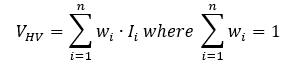
Where:
w is the weight associated to each indicator.
I represents the normalized value of each indicator, selected as relevant for HV.
n is the total number of indicators to consider.
Further information regarding the used indicators depending on the site and hazard as well as the assigned weights is accessible through Deliverable 1.4 “Predictive Models of R-Labscapes” (see button on the upper right side).
Method 2: Survey Assessment
Due to the small extent of the R-Lab of Zadar and the desired output resolution for the risk of coastal floods at building level, a different methodology had to be applied here, consisting of four steps:
Step 1: Heritage Mapping
First, using available data from the Geoportal of Cultural Property, the geoportal site of Croatia, UNESCO and Google maps, the cultural sites of Zadar were mapped. For the heritage value assessment, 13 cultural sites which can be assigned to a specific building (complex) were selected.
Step 2: Survey Development
A survey was developed to determine their heritage values and relationships with vulnerability across eight dimensions:
- Recreation or aggregation
- Spiritual or religious
- Education
- Workmanship, technological and traditional knowledge
- Authenticity and history
- Individual or collective memory and sense of place
- Entertainment or tourism
- Aesthetic
The survey was based on two questions per site. The first one was asking to assign a score between 1 (“very low”) and 5 (“very high”) reflecting the cultural significance of the mapped sites/buildings in Zadar for each of the listed eight heritage value dimensions. Considering the scores assigned to each value in the previous question, the second required to indicate whether it may increase or decrease the vulnerability of the cultural site in the event of a coastal flooding or if it is not assessable. For instance, considering an historical building with high authenticity value, participants should determine whether it may increase vulnerability due to its age and/or conservation state, or it may decrease vulnerability, due to a reinforced sense of place.
Step 3: Survey Distribution
The survey was sent out to four experienced local experts, representing the fields of cultural site management, public administration and museum curation.
Step 4: Heritage Value Computation
For the final assessment, the average heritage value scores for each heritage dimension and site were computed and the polarity was determined based on the majority of experts’ responses. The heritage value was left unchanged if more experts assumed a positive polarity, meaning a contribution to vulnerability. For the opposite case, meaning a negative polarity and a decrease in vulnerability, the additive inverse of the determined heritage value was considered for the analysis (meaning if the heritage value was 5, in the calculation, it would be considered as -5). If at least 50 percent of experts deemed the polarity to not be assessable, the value dimension was not considered for the analysis. Similarly, if the experts were evenly split between assuming a positive and negative polarity, the respective heritage dimension was discarded for this heritage site.
Subsequently, the unweighted average of all heritage dimensions was computed, individually for each site. Afterwards, the values were normalised using the min-max approach with a final range between 1 and 2. Thus, the final result of this analysis was a heritage value index that contains one value for each site which reflects not only different dimensions of heritage values but also takes into account whether these dimensions contribute to or reduce vulnerability.
This can be visualised through the Figure below, which shows the different cultural heritage sites and their determined vulnerability based on the heritage value assessment, with higher values representing higher vulnerability and ultimately risk towards coastal flooding. This approach may be adapted to other locations, hazards, assessment scales and expanded to include natural and/or intangible heritage sites, depending on their relevance in different contexts.
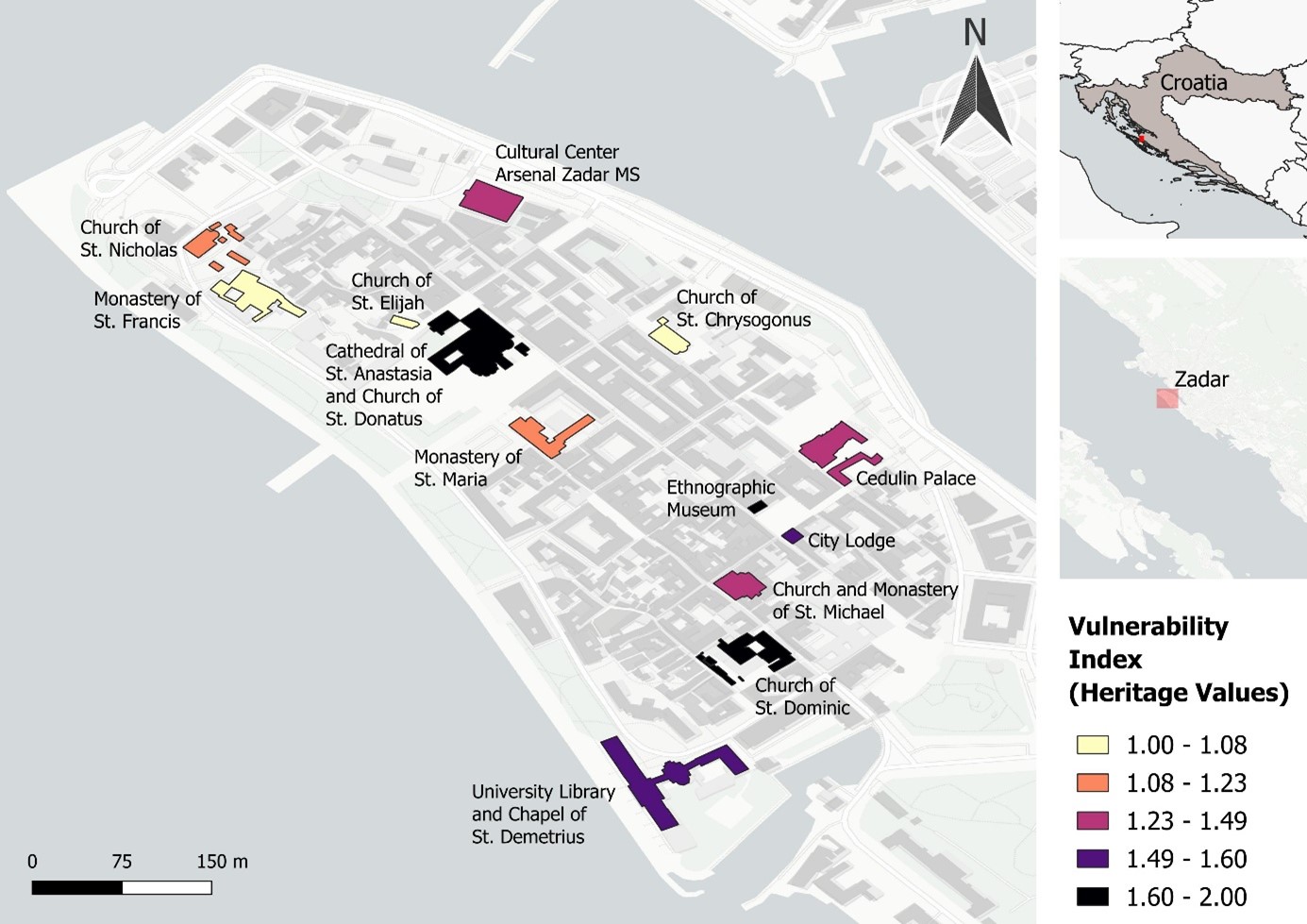
Vulnerability determined through heritage value assessment per cultural heritage site on the Zadar peninsula.