Co-Creation of Resilience Measures and Solutions
The RescueME task “Co-creation of local resilience measures and solutions” was intended to identify and co-create resilience measures and solutions that are applicable in the R-Labs (the RescueME case studies) by actively engaging with the cultural and creative sectors, along with a diverse range of local stakeholders. This activity aims to strengthen community resilience, promote the recognition of local cultural heritage, and actively contribute to innovative resilience solutions that address identified climate-related challenges and their impact on cultural landscapes in each pilot area.
The approach was structured in three main steps, and it collects input from other activities conducted by other partners in the project, thus giving continuity to the work done previously in the project. A detailed description and objectives of each step are defined below:
Step 1: Define key issues and priorities
The first step aimed to define key issues and priorities in the R-Labs (the RescueME case studies) by identifying the most pressing problems and areas of concern, and by understanding what matters most and what needs to be addressed urgently to enhance resilience.
For this purpose, this step was built on the results obtained from three different activities conducted previously in the project:
- The RescueME Resilience Baseline Assessment is an analysis aiming to gather customised information of the local context of the R-Labs and evaluate the weaknesses and strengths in different dimensions: social system, finance, natural environment, built environment, etc.
- The RescueME Impact Chains workshops were held with local stakeholders to identify risks, hazards, exposures, vulnerabilities and impact of and on the cultural landscape, in order to understand cause-and-effect relationships.
- The results from the Impact Chains and the Resilience Baseline Assessment are available in the project website in this document.
- Multiscale Risk and Resilience Assessment of Coastal Cultural Landscapes was an assessment aiming to support the creation of predictive impact models for each R-Lab that focus on assessing risks to cultural landscapes from different hazards. With the data provided by the R-Labs to a questionnaire, it was possible to identify which hazards the R-Labs are facing to and what the challenges caused by the hazards are.
The results of these three previous activities allowed to identify a long list of issues or challenges facing the cultural landscape per R-Lab. These issues address different key aspects of cultural landscape’s resilience: economic activities, knowledge sharing, preparedness for extreme situations, socio-economic trends, condition of physical properties, etc.
That long list of issues is then analysed on an impact/complexity matrix, where a prioritisation exercise with the R-Lab coordinator is conducted to determine the importance and impact of each issue. The matrix was used to evaluate resilience issues based on their potential impact if addressed and the complexity involved in resolving them. An overview of this exercise is shown in the following picture.
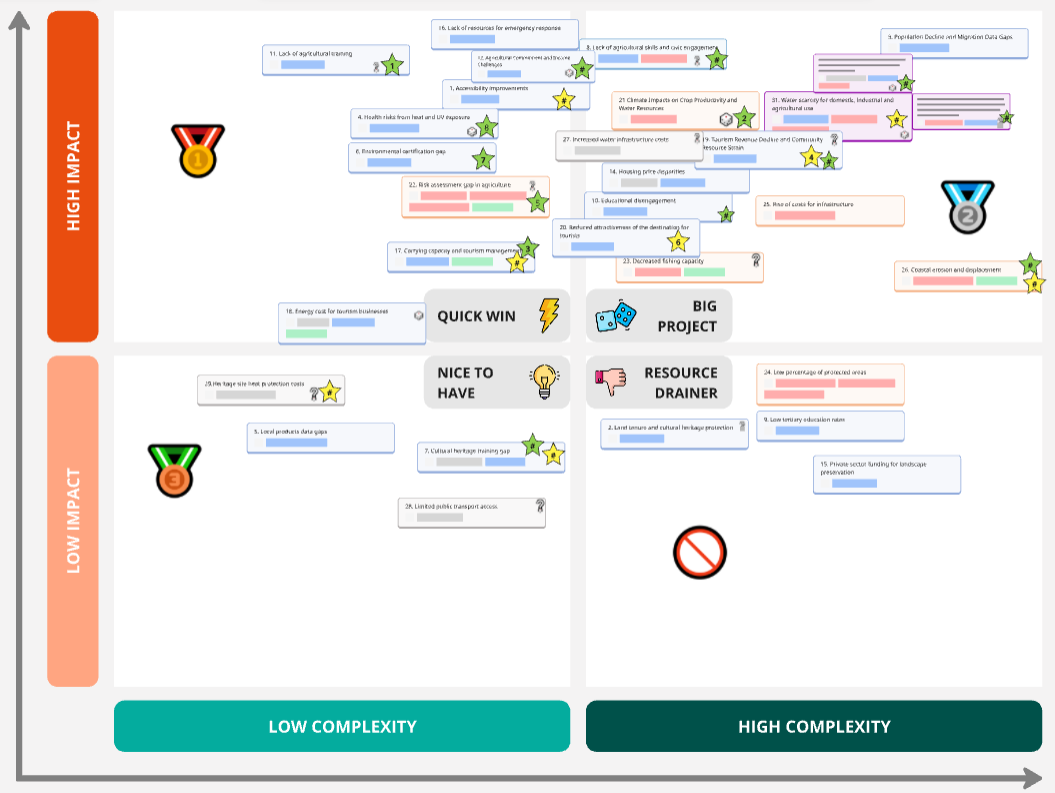
Example of a prioritisation activity conducted in the impact-complexity matrix for Psiloritis in Crete
As shown in the picture, the issues were classified according to the impact they would generate if solved and to the level of complexity to get solved. This exercise maps the big projects, quick wins, nice to have interventions and resource drainer activities that could be conducted in the pilot area. From this prioritisation exercise, the R-Lab coordinators were able to select the issues that they wanted to focus on in this activity. This activity was conducted individually with each R-Lab.
Step 2: Identify potentially compatible solutions
After having defined the issues that will be addressed, the second step aimed to identify potentially compatible solutions, by evaluating various solutions and measures that have been successful for the identified issues and priorities in similar contexts. The main objective was to explore a range of possible solutions that could work for the R-Lab or that could also serve as inspiration to design a solution that fits their needs.
For this purpose, the RescueME Resilience Meta-Repository was used, which is an interactive solutions catalogue with over 1000 resilience solutions for coastal heritage protection and climate adaptation. From this long list of solutions, the metarepository played a key role on the search of solutions that best fit the challenges identified in the previous step and that could be potentially replicable in the local context. The result of this second step was a list of solutions for each of the prioritised issues in step 1.
Step 3: Adapt solutions to the local context
The identified solutions were taken as a reference to shape the third step of the task, focused on adapting solutions to the local context. This step was designed in a way that the selected resilience solutions fit the unique characteristics, needs, and capacities of the R-Labs, ensuring that the solutions are practical, culturally appropriate, and effective in the specific local context.
For this, the AuzoLabs methodology is followed, developed by Conexiones Improbables, which is a process that involves external facilitators and collaborative workshops with local stakeholders to co-create practical and innovative resilience solutions tailored to each case’s context. This initiative focuses on solutions emerging from multidisciplinary collaboration, shaped through creative methodologies. These methodologies foster participatory innovation, ensuring that the solutions are deeply rooted in the local context and respond to specific local challenges.
A key aspect of this initiative is the role of the artist (or expert facilitator), who acts as a coordinator of collaborative processes, integrating participatory methodologies, interdisciplinary approaches, and creative experimentation. Their goal is to support the development of actionable strategies. This initiative is not a theoretical exercise, but rather a practical, community-driven methodology that builds upon:
- Existing research / project inputs: Addressing previously identified key issues, and utilising solutions from the metarepository.
- A structured co-creation process: Actively engaging local stakeholders in the design of solutions tailored to their community.
- A focus on territorial realities: Ensuring that each intervention responds to the specific issues identified in the prioritisation exercise and the solutions identified in prior steps.
The development of this step was structured on three sub-phases:
Step 3.1: Stakeholder engagement and formation of working groups:
- Each R-Lab identifies and selects the most relevant stakeholders for the action. The stakeholders will be selected based on the challenges that will be addressed in the co-creation activities.
- Interdisciplinary working groups are formed to collaborate in the co-creation process.
- Online sessions introduce the initiative and prepare participants.
Step 3.2: Online co-creation sessions:
- Facilitated sessions take place, where stakeholders develop resilience solutions using creative methodologies.
- Ideas are refined through feedback and iterative discussions.
Step 3.3: Final in-person sessions and validation
- Each R-Lab holds an in-person workshop to consolidate and validate the proposed solutions.
- The feasibility and implementation pathways are refined.
- Final solutions are documented.
The main result of this process is the development of a list of actions to be implemented in the future, which address the key issues identified and enhance the resilience level and risk preparedness of coastal cultural landscapes. The process also produces collateral benefits, such as strengthening relationships and cooperation between different local actors, which is essential for achieving the proposed objectives and actions.