RescueME Transformative Pathway Monitoring
What are transformative pathways?
Transformative Resilience Pathways (TRPs) are gradual and flexible sequences of actions that require continuous learning and adaptation. In RescueME, they are conceived with a specific focus on coastal areas, which have historically been centers of human settlement and now face profound uncertainty due to the effects of climate change, natural hazards, and other anthropogenic pressures such as pollution and overtourism.
In this context, static planning approaches are inadequate because they do not allow policies to evolve in response to new information and emerging events. The objective of the TRPs is to provide informed and up-to-date support to decision-making processes in both the short and long term.
The central role of monitoring
Monitoring plays a central role in TRPs, as it represents the transition from theoretical planning to the empirical validation.
This strategic phase enables, through continuous evaluation of the implemented action sequences, the adjustment of course or a restart if any component of the chain fails to achieve the predefined objectives. In this way, TRPs are configured as dynamic and adaptive systems, capable of evolving on the basis of the evidence collected.
Measurability and relevance are key elements of this process: without a monitoring system based on clear and operational indicators, progress toward resilience in the target territories would be neither quantifiable nor assessable and an effective monitoring also ensures that the information produced is timely, reliable, and directly useful for the needs of end users and local communities. This transforms resilience from an abstract concept into an operational management tool, enabling communities to know when to intervene and to verify whether the adopted solutions are actually delivering the expected results.
Dynamic Adaptive Policy Pathways (DAPP)
Within this context, RescueME T1.5 – Transformative Pathway Monitoring focused on Dynamic Adaptive Policy Pathways (DAPP) framework [1].
Unlike traditional methodologies, DAPP is explicitly designed for decision-making under deep uncertainty, avoiding reliance on a single forecast and instead supporting decisions that remain effective across a range of potential futures.
By using pathways, the framework facilitates strategic transformation rather than rigid planning and integrates a continuous monitoring system as a crucial element, enabling timely and proactive adjustments.
Monitoring within a DAPP framework is based on a series of key elements:
- Indicators, also referred to as “signposts,” are elements monitored to signal when a potential risk or trigger is approaching or to assess whether the plan is achieving its intended objectives [2].
- Adaptation thresholds, also called “adaptation tipping points,” are critical failure thresholds that must be avoided, as they indicate the point beyond which current strategies are no longer sustainable or effective in meeting the plan’s objectives [2][3][4].
- Triggers, also referred to as “decision points,” are values reached by an indicator that represent critical decision-making moments. At these points, the effectiveness of ongoing actions must be reviewed, and, if necessary, new adaptive pathways and actions should be selected to avoid reaching the adaptation threshold or critical limit [1][2][5].
- Signals, also known as “early warning signals,” are values of indicators suggesting significant changes that a trigger may be approaching [5].
DAPP integration within the RescueME Framework
DAPP aligns with the RescueME objective of developing TRPs that address urgent short-term challenges while steering toward long-term transformative change, integrating disaster risk management and adaptation actions.
Therefore, the integration of the DAPP methodology within the RescueME framework (Figure 1) provided a structured approach to planning and monitoring resilience in cultural landscapes. This integration represents a collaborative and multi-level process in which the work is shared between the methodological development (done by the RescueME project) and the operational application (done by users and local stakeholders).
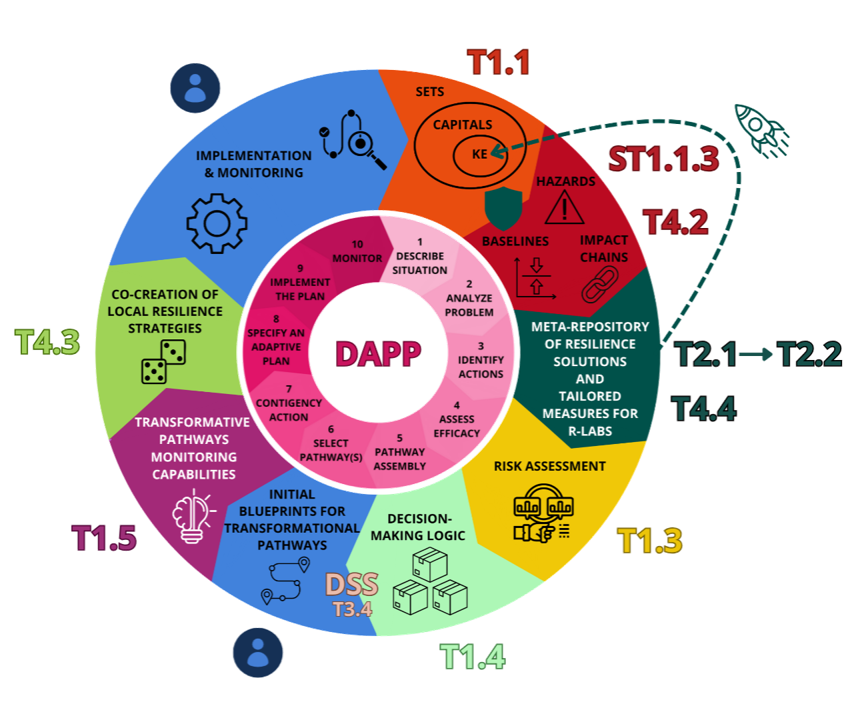
The diagram illustrates the integration of the DAPP methodology within the RescueME framework
Building on the ten steps of the DAPP framework, this integration unfolded as follows:
- Description of the study area/system: cultural landscapes were conceptualized in RescueME as Socio- Ecological-Technical Systems (SETS), described through five capitals (natural, social, financial, human, built) and the identification of key elements that enhance their resilience [6].
- Problem analysis: RescueME hazards and stressors affecting capitals and their key elements were characterized, creating local resilience baselines and impact chains for the Resilience Historical Labscapes (R-Labs), the RescueME project’s demonstration and validation sites [6] [7].
- Identification of potential adaptive actions: during RescueME project, Resilience Solutions were collected from previous projects in a meta-repository and co-created tailored to R-Lab contexts. Resilience solutions are defined in RescueME as practices, products, processes, actions, and initiatives available from both previous research projects that represent innovative, cooperative, and applicable strategies for resilience, closely connected to culture and the environment, aimed at addressing climate change, natural hazards, and societal and other crises [8].
- Assessment of actions’ effectiveness under different scenarios: the impacts of climate and hazards on cultural landscapes, heritage values, and ecosystem services were assessed in RescueMe using predictive models. This enabled quantification of effects on both tangible and intangible assets, supporting risk-informed decision-making [9].
- Pathway assembly: a methodology to construct innovative packages of measures, grouped according to their compatibility and effectiveness, was developed within RescueME. The selected measures come from the developed meta-repository of solutions and are linked to predictive impact modeling to quantify their expected effects. This methodology supports the decision-making process and was implemented within the digital platform of Incremental Spatial Decision Support System (ISDSS).
- Selection of preferred pathways: the user can access the ISDSS through the ATLAS [10] access point, conceived as an online interactive visualization platform designed to present, in a user-friendly manner, knowledge related to the typologies of European coastal cultural landscapes, based on the five “capitals”, and their impacts associated with climate change and other threats. The output of the decision-making phase is the definition of a strategic blueprint, understood as an integrated configuration of packages of measures.
- Identification of contingency actions: this aspect is addressed in the Task 1.5, which identified the methodology for selecting indicators to monitor each package (Figure 1). These monitoring capabilities, integrated in the ISDSS, involve:
- Component selection: selecting the solution package, the relevant hazard, and the type of capital addressed.
Example: select a package of measures, the flood risk and human capital (specifically, the key element “education”).
- Macro-themes identification: within the package, grouping the solutions aspects that influence key elements into coherent thematic groups.
Example: consider a package of three solutions. The first solution consists of the development of green spaces through a participatory approach, supported by research projects and on-site training activities. The second focuses on the design of an urban park aimed at raising public awareness through direct park-based experiences and educational seminars on climate risk. The third involves the redevelopment of an area implemented through a participatory planning process.
In this simplified scenario, the main categories of solution components related to training and educational aspects could include: (a) participatory approaches; (b) research projects; (c) seminars; (d) on-site training; (e) experiential learning through green spaces.
- Indicators definition: identifying which indicators can measure the progress, or regression, in the resilience of the key element through the aspects proposed by the NB solution implemented against the hazard.
Example: for the macro-theme “on-site training “, the chosen indicators could be the “number of training activities carried out” and the “citizen participation rate”.
- DAPP association: linking each indicator to signals, triggers, and adaptation thresholds for dynamic monitoring.
Example (Participation Rate):
- Signal: A slight decline in participation in training activities compared to the previous year (early warning).
- Trigger: Participation drops below a critical threshold (e.g., -30%). At this point, decision makers must reassess the engagement strategy before it becomes useless.
- Adaptation Threshold: A persistent and drastic decline in participation that renders the solution (training) completely ineffective in protecting the population.
8. Specification of an adaptive plan: co-creation of local resilience strategies with stakeholders is supported by the Resilient Landscapes Serious Game.
9. Implementation: the concrete implementation of these solutions takes place at the local level, where users employ the ISDSS and the solutions identified in the meta-repository to design and implement the most appropriate measures for their specific context.
10. Monitoring: to assess the effectiveness of the implemented strategies, local stakeholders carry out continuous monitoring of the indicators, based on the capabilities provided through Task1.5. When the trigger point of one or more indicators is reached, a reorientation mechanism is activated, restarting the DAPP cycle. This iterative logic ensures the progressive adaptability of the decision-making system and the possibility to learn from the outcomes of the strategies already implemented.
[1] Haasnoot, M., Kwakkel, J. H., Walker, W. E., & ter Maat, J. (2013). Dynamic adaptive policy pathways: A method for crafting robust decisions for a deeply uncertain world. Global Environmental Change, 23(2), 485–498. https://doi.org/10.1016/j.gloenvcha.2012.12.006
[2] Allison, A., Stephens, S., Blackett, P., Lawrence, J., Dickson, M. E., & Matthews, Y. (2023). Simulating the Impacts of an Applied Dynamic Adaptive Pathways Plan Using an Agent- Based Model: A Tauranga City, New Zealand, Case Study. Journal of Marine Science and Engineering, 11(2). https://doi.org/10.3390/jmse11020343
[3] Stephens, S. A., Bell, R. G., & Lawrence, J. (2018). Developing signals to trigger adaptation to sea-level rise. Environmental Research Letters, 13(10). https://doi.org/10.1088/1748-9326/aadf96
[4] Stephens, S., Lawrence, J., Allison, A., Boyle-Gotla, A., & Stephens, S. A. (2021). Adaptive tools for decisions on compounding climate change impacts on water infrastructure. Australasian Coasts & Ports 2021 Conference – Christchurch, 30 November – 3 December 2021. https://doi.org/10.3316/informit.262024121050250
[5] Lawrence, J., Bell, R., Blackett, P., Stephens, S., Collins, D., Cradock-Henry, N., & Hardcastle, M. (2020). Supporting decision making through adaptive tools in a changing climate Practice guidance on signals and triggers. National Science Challenges. Victoria University of Wellington
[6] Gandini, A., Egusquiza, A. (2023) “D1.1 – Actionable Resilient Historic Landscape Framework”, RescueME project
[7] Wischott, V., Ugalde, I., Pirazán-Palomar, L., Angelone, S., Milde, K., Lückerath, D., Klose, A. (2024) “D4.3 – Local resilience baseline and local Impact Chains for R-labscapes”, RescueME project
[8] Bravaglieri, S. & Santangelo, A. (2025) “D2.1 – RescueME resilience meta-repository”, RescueME project
[9] Calvet, M. A., Abajo, B., Gandini, A., Egusquiza, A., Baldassarre, B., Schlechtendahl, J. F., De Luca, C., Manojilovic, N., Karatnik, O. (2025) “D1.4 – Predictive models of R-Labscapes”, RescueME project
[10] Klose, A., Abajo, B., Lopez de Aguileta, A., Gandini, A., Egusquiza, A., Usobiaga, E., Benedito, M., Zubiaga, M., Simon, A., Santangelo, A., Salpina, D., Manojlovic, N., Durrant, L. (2024) “D1.2 – ATLAS of european coastal heritage landscape typologies and climate change impacts”, RescueME project